
July 2025 - Get Fit For Duty Research Newsletter
Updated: Apr 14
Welcome
Hello & Welcome to the Get Fit For Duty Research Newsletter!
The aim of this newsletter is to provide a monthly update on recent research focused on the health and wellbeing of firefighters. Each month will aim to have a guest researcher, who will give a insight into their current research and the positive impact their work will make to firefighters.
If you are currently undertaking research within the fire service sector, we would love to hear about your project, please email us at info@getfitforduty.co.uk.
Included in the JULY newsletter,
Scroll down to read the JULY edition of our newsletter.
July Monthly Roundup
Hello,
We are now into the third issue of this newsletter. This month I had the opportunity to attend the Asian Fire Service Association (AFSA) conference, hosted by Essex County Fire & Rescue Service. The conference programme was filled with great speakers, some sharing inspiring stories of their journeys within the emergency services.
The theme of the conference was “Inclusive by design”. The overall aim was to delve deeper into real-world issues with practical, case study-based sessions that focused on implementing inclusive initiatives, creating a sense of belonging in the workplace and empowering employees to bring their full selves to work.
I had a great time meeting like minded professionals from emergency services across the United Kingdom and I look forward to attending future AFSA conferences.

As mentioned previously, to help build this community, I need your help. If you know anyone who would be interested in this newsletter, please share it on your social channels and invite them to join our group on LinkedIn. Simply search for “Get Fit For Duty - Firefighter Health & Wellbeing Group”
Stay healthy,
Dr Liam Noll
Sport & Exercise Science, PhD
July Research Focus - Lee Waters, Director of Clear Waters Sports Vision
For this month’s issue of the Get Fit For Duty Research Newsletter, I am pleased to introduce Lee Waters, Director of Clear Waters Sports Vision. Lee is passionate about researching the impact of using eye tracking and cognitive load in training and development in the fire service.
Please tell us a bit more about yourself & your background
My name is Lee Waters and I am known in high-performance circles as “The Eye Guy. As a leader in visual and cognitive performance I combine deep academic expertise with practical insight into the high performance environments I have had the absolute privilege to work in. With over 20 years of experience teaching in further and higher education, I am a Senior Lecturer (HEA) on a part time basis at the University of Northampton and in in the final stages of completing a PhD focused on perceptual-cognitive performance under pressure.
Academically, I hold a BSc in Applied Sport Science and an MSc in Applied Sport and Exercise Psychology, as well as being a Primary Practitioner in Rational Emotive Behaviour Therapy (REBT). This combination of experience and qualification provides a uniquely integrated approach to both the mental and perceptual demands of elite performance.
I consistently apply cutting-edge research in eye tracking and cognitive load to help individuals and teams understand, train and develop to ultimately perform optimally in high-pressure settings. My work spans across elite sport and beyond, including world-leading projects with the International Ice Hockey Federation (IIHF), England Cricket, and equestrian show jumping (to name a few), examining how visual behaviour and cognitive load affect split-second decisions and performance outcomes.

I have delivered workshops, training days and talks in a variety of settings ranging from a TEDx talk (here) on the science of visual and cognitive performance through to a showcase event recently in Dubai to a number of transport, health and education professionals.
Looking ahead, I would love to focus efforts on bringing these innovations into the emergency services, particularly the fire service, where I believe eye tracking and cognitive load monitoring can play a crucial role in improving situational awareness, decision-making, and safety in high-stress, time-critical environments.
Please tell us about your research topic & what makes your passionate about this area of study
My research focuses on visual behaviour and cognitive load in high-performance environments, with a particular emphasis on eye tracking technology and how it can be applied in real world performance contexts, not just labs or fabricated unrelated activities. While eye tracking has existed for over 100 years and is well researched, much of that research has been conducted in artificial, highly controlled environments. This creates a disconnect when the findings are then applied to complex, dynamic situations such as elite sport or emergency services.
My passion lies in bridging that gap. Gaze behaviour is scenario-dependent — it changes based on what the person is facing. So, to really understand how someone sees and processes their world, we must assess them in environments that accurately reflect the pressures, distractions, and cognitive demands of their performance setting. Watching a flashing light in a lab is not the same as making decisions in the chaos of an ice hockey game or while navigating a vehicle through a busy city.
That’s why in my research, participants wear the eye tracker while performing their actual sport or profession as much as possible, not while watching someone else do it on a screen. For example, riders wear it while jumping, dealing with mistakes, reacting to the horse’s behaviour. Ice hockey officials wear them on the ice during real-game simulations. Cricket players wear it at the crease facing all variations of balls. The goal is to observe authentic visual strategies under real pressure, not a diluted version of them.
Ultimately, what drives me is the opportunity to unlock how people really make decisions. If we can understand how they use their visual system in the environment where they’re ultimately judged, then we can make training more accurate, consistent, and effective. That unlocks the true power of decision-making and has the potential to push performance to the next level.
This also allows us to challenge outdated or narrow training assumptions, like "just focus on the puck" or "scan faster", by offering objective insight into what top performers are actually doing with their eyes. It removes guesswork, bias, and assumptions and gives coaches and athletes real data to work with.

What inspired this journey and keeps you motivated?
Funnily enough, it all started with the documentary “Cristiano Ronaldo: Tested to the Limit”, and the section on eye tracking by Jon Ward and Zoe Wimshurst. I remember watching it and thinking, “This is where I want to go.” Years later, I’ve had the privilege to meet and speak with both, they’re brilliant people and true pioneers in this space. Their work, combined with my frustration at the lack of real-world applicability in much of the training I saw, really lit the fire in me.
What continues to drive me is the genuine awe and excitement people show when they try eye tracking for the first time. I haven’t had a single athlete, coach, official, professional, put the glasses on and not be amazed by what they reveal. Beyond that initial "wow" moment, I love the conversations that follow, learning how they think, see, act; it’s the closest I’ll ever get to being inside their minds. That process of discovery and collaboration fascinates me.
And though I used to struggle with education myself, I now proudly consider myself an applied academic — someone who learns, applies, and pushes boundaries. That mindset helped me navigate huge challenges like running an on going fully live eye tracking project with IIHF female and male officials during World Championship games, with millions of viewers and elite players on the ice. From adjusting helmet fits to solving connectivity issues in arenas packed with 12,000+ fans, every step has been about innovation under pressure.
I’ve also faced resistance — from those who believe bodycams or headcams are enough, or from people using simplified training approaches based on limited understanding. But instead of pushing back aggressively, I stay focused: I keep demonstrating that decision-making is more than just reaction time. My approach is holistic and representative. I use flashing lights too, sure, but as one small tool in a broader, more meaningful programme.
And yes, getting participants to wear eye trackers during performance is a hurdle, but with good orientation and support, it becomes second nature. One rider recently told me: “Once I started cantering, I forgot I even had them on.” That’s when you know the approach is working, when tech fades into the background and the insight it brings comes to life.
How do you hope your research can help address current challenges firefighters face in terms of health & wellbeing?
Firefighters operate in some of the most cognitively, emotionally, and physically demanding environments imaginable. Split second decisions in unpredictable, high-risk settings can literally be the difference between life and death, not just for themselves, but for others. While physical fitness and tactical training are rightly prioritised, one area that remains largely underexplored and undertrained is cognitive performance under pressure — particularly how the visual system and mental load impact critical decision-making. That’s where my research can make a transformative difference.
By applying eye tracking and cognitive load measurement in realistic fire service simulations, we can generate unmatchable insights into how firefighters see, interpret, and act in dynamic environments. We’re not just asking how fast someone reacts, we’re asking what are they focusing on? What are they missing? When is their brain becoming overloaded? And how does that impact the quality of their decisions?
Let me give you a tangible example:
Imagine a firefighter enters a smoke-filled structure wearing a lightweight, non-intrusive eye tracker. We can track exactly where their eyes go when searching for victims, assessing structural risk, locating hazards, or communicating with team members. Are they hyper-focusing on one area and missing peripheral cues? Are they visually scanning in effective patterns? Are they hesitating or rushing because their cognitive load is spiking?
Now combine that with cognitive load data, which tells us when their brain is becoming overloaded. You can see in real time when the firefighter becomes mentally saturated — which often happens well before a critical error occurs. That information is gold for debriefing, targeted training, and mental resilience work.
This isn’t just theoretical. We’ve already seen these insights revolutionise how elite athletes — from ice hockey players to showjumpers to cricket officials — prepare and perform. Eye tracking has helped athletes reframe how they approach scanning, anticipate play, and stay mentally sharp under fatigue. Why wouldn’t we offer the same edge to firefighters, who are also performing in time-pressured, chaotic, high-stakes scenarios?
In training contexts, this approach can:
Diagnose weaknesses in visual search strategies, situational awareness, or communication under pressure.
Tailor training to an individual’s cognitive strengths and weaknesses.
Validate or challenge current practices. For example: Are crew members truly scanning their environment as instructed, or are they over-relying on routine patterns? Do current training drills mimic the actual cognitive demands faced on scene?
From a wellbeing perspective, the potential is even greater. Chronic exposure to high-pressure environments without cognitive decompression can lead to burnout, mental fatigue, and long-term health issues. Eye tracking and cognitive load tools can act as an early warning system, helping teams and leaders see when someone is nearing cognitive overload before it translates to poor decisions or deteriorating mental health.
Let’s also talk about team dynamics. With group-based tracking, we can examine how teams visually coordinate during complex operations. Are leaders overburdened because others aren’t visually scanning? Are key hand signals or cues being missed? That kind of insight isn’t available through observation alone — you need the hard data that only this technology can provide.
There’s also huge potential for incident review and debriefing. Instead of relying on memory or assumption, imagine being able to say, “Here’s exactly what you looked at, when, and what your mental load was like in the moment.” This isn’t about catching people out — it’s about understanding how they think, so we can support them more effectively.
To be clear, this is not about replacing current methods — it’s about enhancing them. Eye tracking and cognitive load monitoring are tools that empower firefighters and trainers with clarity, accuracy, and objectivity. They allow us to truly understand the 'why' behind the 'what' — and that’s the key to long-term performance, safety, and wellbeing.
So, my goal is simple but powerful:To bring representative, real-world, cognitive science into the fire service, to help firefighters train smarter, respond more effectively, and protect their mental and physical health over the long term. We owe it to those who put themselves on the line to give them every tool possible to stay sharp, safe, and supported.
Could you share some findings/results from your research so far?
Absolutely, and I’ll be honest, this is where things get really exciting. Over the past few years, my research has demonstrated that eye tracking can move beyond the lab and be integrated directly into real-world environments with seamless effectiveness. I’ve now used this technology across a wide spectrum of high-performance domains — including ice hockey (players and officials), showjumping, taekwondo, rugby, cricket, netball, basketball, handball, and golf.
That might sound broad, but the purpose has been very focused: to prove that eye tracking must be studied in the actual environments where decisions happen, not in disconnected simulations.
For example, in golf, I’ve literally walked full 18-hole courses alongside players wearing Tobii Pro G3 glasses, not just to study tee shots or putting, but everything from short game mechanics, club selection, course management, and even how they visually recover after a poor shot. When golfers encounter hazards like bunkers or water, we can now see how their gaze behaviour changes in real time — what they focus on, what they avoid, and how that impacts ball contact. Players have described this feedback as incredibly practical, far from the “fluffy” analysis they expected.
In equestrian sport, we’re tackling a long-standing debate around what riders should focus on when approaching a jump. Some coaches say fix on the top pole of the fence until take-off. Others say shift to the landing zone once the stride is confirmed. Some even promote tracking the ground up and over the jump. Until now, that’s all been theory or preference. But with our first-of-its-kind live mounted eye tracking study, led alongside Eva Marunova and Roberta Blake, we’re capturing what riders actually do, during live jumps — and how that links to stride accuracy, mistake recovery, and medal-winning performance.

So far, we’ve seen that:
Checking the jump early is critical.
Riders who can reset visually after an error are more likely to perform consistently.
And, crucially, coaching approach impacts gaze behaviour, which in turn affects success.
But the most groundbreaking work to date has been in ice hockey, where we achieved multiple world-firsts in the female and male arenas: officials wore eye tracking technology during live matches at U18, U20 and Senior World Championships in Switzerland, Finland, Sweden and Romania, some featuring two or three officials on the ice with trackers at once.
These were games with huge audiences, high stakes, and elite pressure, and we captured exactly how officials scanned the play, tracked players, processed collisions, and made instantaneous decisions. The data generated from those tournaments is something we’ve never seen before in this context and it’s already informing ways to train officials, design drills, and improve consistency under pressure.
A few specific findings from across these environments stand out:
Gaze behaviour is highly situation dependent. One of the clearest insights my work has confirmed is that what someone looks at — and how they look at it — changes dramatically based on the specific scenario they are in. That might sound obvious, but the implications are huge: if we train people in the wrong context, we risk developing visual behaviours that are detrimental when transferred into the real setting. That’s why realism matters in sport, in medicine, and most importantly, in firefighting.
We’ve also made novel progress in understanding the link between screen time and cognitive load, and how this can compromise the effectiveness of the visual system. When training relies heavily on screen-based simulations, we’re seeing that prolonged exposure can increase cognitive fatigue and reduce the ability to filter relevant information in fast-moving real-world environments. In other words: too much screen time in training could dull the brain’s edge when it’s needed most.
These insights are not just nice to know, they are need to know if we want to train for real-world performance.
And that brings us to the fire service.
All of these findings have direct implications for firefighters:
Training scenarios must replicate the visual and cognitive conditions of the incident ground.
If gaze behaviour isn’t assessed in context, we may be building habits that fall apart under pressure.
And if we monitor cognitive load during live training, we can understand when individuals are at risk of making critical errors — and help prevent them before they happen.
This is what makes eye tracking and cognitive load monitoring such a powerful, unmatched diagnostic tool. It lets us see, with total clarity, how people make decisions, process information, and perform under stress. It also gives us a way to challenge assumptions, refine training practices, and protect wellbeing by identifying overload, fatigue, and burnout before they become dangerous.
Personally, this work has been some of the most fulfilling, nerve-wracking, and rewarding of my career, especially during the IIHF world championships, which pushed every limit of planning, pressure, and innovation. I owe massive thanks to Jon Ward at Tobii, the team at SOMAReality, as well as Joel Hansson, Danny Kurman, Masi, and Patrick at IIHF, and to the pioneering officials like Riku Brander, Daniel Erickson, Kilian Hinterdobler, Shane Gustafson, Karin Williner and Sydney Harris who wore the tech under global scrutiny and made it all possible.
In short: This technology works. It works in elite sport. And it will work for firefighters.Because whether it’s a gold medal or someone’s life on the line, the visual-cognitive system drives decision-making. And now, for the first time, we have the tools to truly understand and improve it.
Where can our readers learn more about your research project?
TEDx Talk: “Do You See? Using the Eyes to Improve Decision Making” — a deep dive into how eye tracking uncovers hidden processes behind elite performance. Watch it here: https://youtu.be/p-3cxYPpbao tobii.com+6YouTube+6clearwaterssv.co.uk+6.
Tobii Interview Blog: “Understanding decision-making in sports with eye tracking” — a feature where I explain moving research “out of the lab and into the field.” Read it on the Tobii blog: clearwaterssv.co.uk+3tobii.com+3YouTube+3.
YouTube Interview: A complementary video interview (hosted by Tobii) providing practical examples of how I’ve used eye tracking in elite sports settings LinkedIn+9YouTube+9tobii.com+9.
IIHF Publication: “What you see is what you call” — outlines the world‑first on‑ice eye tracking with hockey officials at junior world championships, and how gaze behavior evolves under tournament pressure IIHF International Ice Hockey Federation+1clearwaterssv.co.uk+1.
What are the future directions for your research?
The next steps in my research are all about continuing to push boundaries, not for the sake of it and not just in terms of the technology I use, but in how we apply the insights to make training and development truly transformational.
I’ve shown that eye tracking and cognitive load monitoring can be used in elite sport environments with high success, but now the goal is to bring that same level of precision, realism, and impact into new high-stakes sectors, particularly the fire service, emergency response, and other critical occupations.
My focus is on a few major directions:
1. Translating High-Performance Insights into Life-Saving Professions
I want to take what we’ve learned in sports like ice hockey, equestrian, and golf, where visual behaviour and mental load directly affect performance and apply those lessons to the fire service. Firefighters operate in chaotic, information-dense environments where split-second decisions can’t be based on guesswork or outdated training principles.
By embedding eye tracking and cognitive load tools into live fire training, simulations, and assessments, we can:
Identify visual patterns that support safer, faster decision-making.
Detect cognitive overload before it leads to errors.
Develop training protocols grounded in real behavioural data — not assumptions.
And ultimately, protect the health, performance, and wellbeing of those on the front line.
2. Setting the Standard for Context-Driven Decision-Making Research
One of the most important findings from my work so far is that gaze behaviour is entirely context-driven. You cannot train decision-making using stimuli or environments that don't reflect reality — doing so risks creating habits that don’t transfer or worse, undermine performance under pressure.
That’s why I’m developing new research to:
Explore how gaze strategies shift across different high-pressure roles — from athletes to firefighters to officials — and what best practice really looks like in each.
Continue breaking away from screen-based simulations and focus on representative, immersive environments.
Challenge traditional approaches that rely on “quick fixes” like reaction drills with flashing lights or abstract stimuli. Those tools may have a place, but only as part of a holistic, performance-specific approach.
3. Building Long-Term, Applied Collaborations
I’m also investing in long-term partnerships with organisations that are brave enough to innovate, like the IIHF, who gave me the green light to run the world’s first live on-ice eye tracking studies. The ECB who are leading the way in understanding what their umpires do during those tight calls. That spirit of openness and experimentation is exactly what’s needed if we’re serious about changing how we train and develop people in high-stakes environments.
I’m now actively seeking to build similar relationships within fire and rescue services, emergency teams, and even military or law enforcement units, anywhere that the cost of poor decision-making is too high to ignore.
4. Creating Tools That Outlive the Research
Finally, my goal isn’t just to publish findings, it’s to create tools, systems, and frameworks that trainers, coaches, and operational leaders can use every day. That might mean:
Portable, real-time feedback tools.
Cognitive performance dashboards.
Or even modular training systems based on real-world eye tracking data.
Because for me, research is only valuable if it makes a difference on the ground.
In short, the future of my work is about going deeper into realism, wider into new domains, and higher in terms of impact. The goal is simple: to redefine how performance is developed, using real data, in real settings, for real results.
If you’re in a profession where every decision counts — I want this work to help you see, think, and perform better than ever before.
How can readers contact you for more information?
You can check out my website: www.clearwaterssv.co.uk
You can also connect with me on LinkedIn
If you want to contact me via email, you can do at lee.waters@clearwaterssv.co.uk
Monthly Question - July
July Monthly Question - “What provisions should be provided for firefighters to support their health, wellbeing & career longevity?”
Thank you to those who reached out and provided their input to this question. I have provided a word cloud image below with the results.
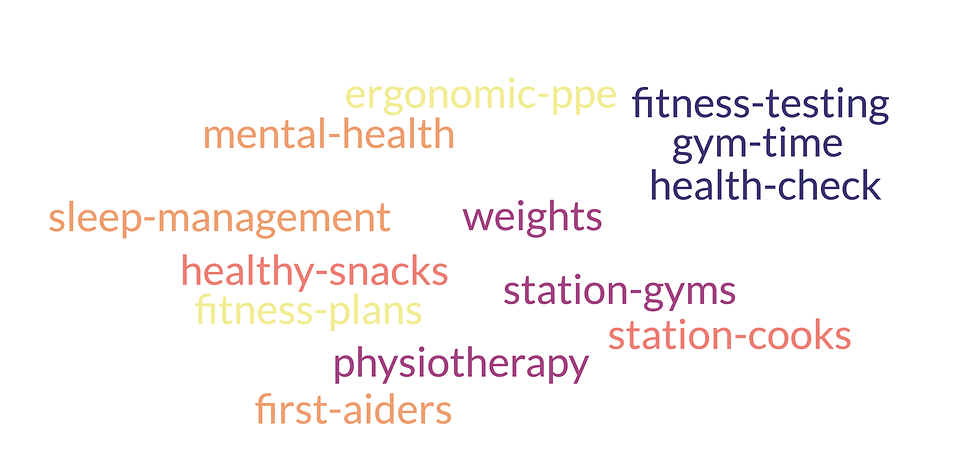
If you have a question you would like answered, please reach out and I will feature it in a future newsletter.
Events - Fitness Events / Conferences
Conferences
If you are planning any fire related events and would like to promote them to like-minded researchers, drop us an email and we can include it in our next newsletter.
The Emergency Services Show - 17th-18th September. NEC Birmingham. Registration is FREE. Click here to book your place.
Fitness Events
If you are taking part in any upcoming fitness events and are raising money for the firefighters charity, please let us know by emailing info@getfitforduty.co.uk.

Comments